On Saint Hildegard of Bingen (via Church Life Journal)
An essay I wrote about the dazzling Medieval visionary and Doctor of the Church, Saint Hildegard of Bingen, was published on her feast day (September 17) a few weeks ago. It has truly been a treat to get to dive into the riches of Hildegard’s theological and pastoral writings this past year, as well as some of the wonderful contemporary scholarship that has been done on her life (I especially treasured my readings from Margot Fassler, Nathaniel Campbell, and Barbara Newman). This essay is another product of my research fellowship with the Sullivan Family Saints Initiative at the McGrath Institute for Church Life.
Read a preview of the essay below, and the whole thing at Church Life Journal (link at the bottom of the post).
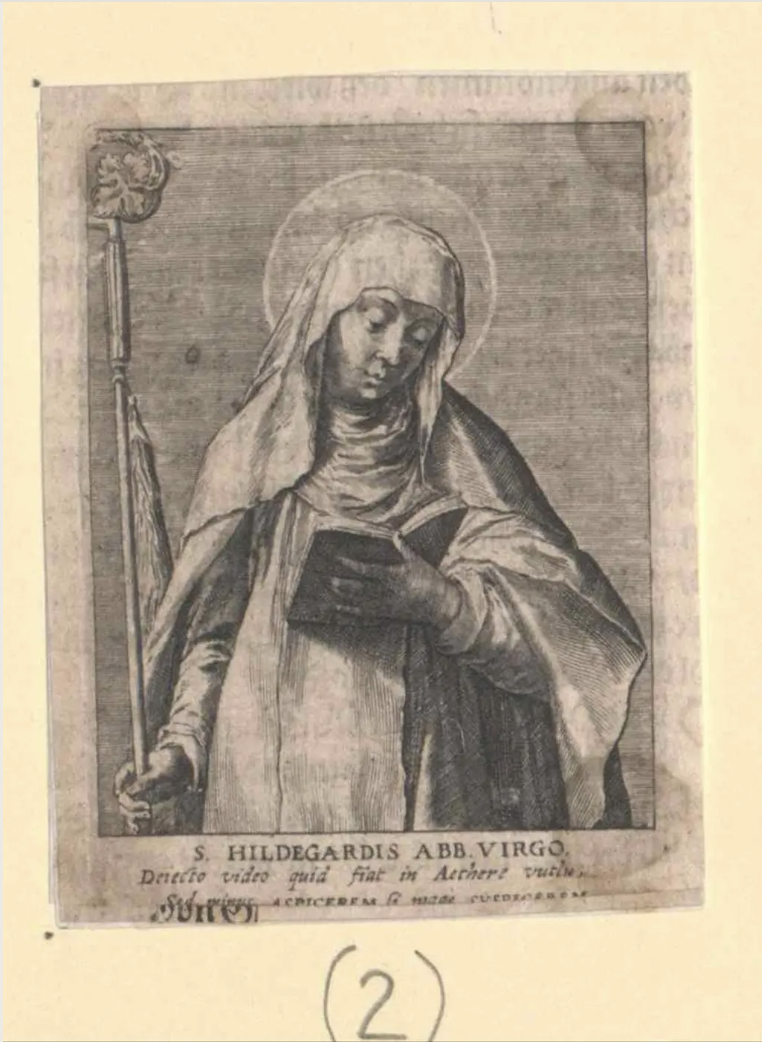
Portrait of Saint Hildegard of Bingen || Source:Public Domain
Medievalist Barbara Newman has characterized the Benedictine Abbess Hildegard of Bingen as “a perfect embodiment of the integrated, holistic approach to God and humanity for which our fragmented era longs.”[1] Pope Benedict XVI similarly observed in Hildegard “a wonderful harmony between teaching and daily life” when he declared her a Doctor of the Church.[2] This harmony especially resounds in her expansive corpus, which Newman describes as uniting “vision with doctrine, religion with science, charismatic jubilation with prophetic indignation, and the longing for social order with the question for social justice in ways that continue to challenge and inspire.”[3]
Only a glance at Hildegard’s extensive list of accomplishments is needed to confirm these characterizations. The Medieval polymath founded two monasteries, went on multiple preaching tours, and wrote musical compositions, theological treatises, the first documented morality play, works on science and natural medicine, and even a secret language that some scholars believe was used to foster solidarity in her Order.[4] Hildegard was renowned for her prophetic insight, which was sought out by her contemporaries, ranging from the women under her care to political and religious leaders. Newman sketches Hildegard’s distinctive personality, vividly:
Her sheer force of will, combined with a dazzling array of spiritual and intellectual gifts, a courage hardened by decades of struggle, and a prophetic person, which she displayed in season and out, made her a formidable opponent; and she did not take defeat easily.[5]
Hildegard placed this vivacity at the service of the twelfth-century Church beset with clerical corruption. It was out of her love for the Church that she advocated for its renewal and internal reform.
The papally endorsed Scivias (short for the Latin phrase Sci vias Domini, meaning “Know the Ways of the Lord”) was a fruit of this love. Scivias is a theological summa, which features twenty-six of Hildegard’s doctrine-inspired visions. In it, she draws on scriptural exegesis, Patristic authors, and contemporary science to show how the history and destiny of creation hinge upon the Incarnation. The illuminated work includes paintings of the visions, designed by the visionary herself and her community. In the preface to Scivias, Caroline Walker Bynum offers the preparatory insight that readers will find in the diverse array of Hildegard’s elaborate visions: that they are being shown the whole “structure of salvation” by the saint herself (5).
Scivias challenges many commonly accepted notions of the Church today, including those that render her primarily (if not purely) in functional terms. In such conceptions, the Church works as an automated “it”: a dispenser of grace via the sacraments—a means to an end for individuals to secure their spots in heaven. This narrowly individualistic vision of the Church can induce a kind of blindness to that profession of early Christians: “the world was created for the sake of the Church” (CCC §760).[6] No one remains alienated in the Church, but discovers, in her sacramental life, that they are made for communion with humankind and with the whole of creation in Christ.
Hildegard can help us see creation anew in light of this communitarian vision of the Church. The otherworldliness of her visions and the richness of her theological analysis can help make strange the all-too familiar Church for us today, and reawaken us to aspects of her identity that we have forgotten. We will sketch only three of Hildegard’s (many) visions of the Church presented in Scivias, to see how the saint artistically and theologically delineates the Church’s understanding of herself.